

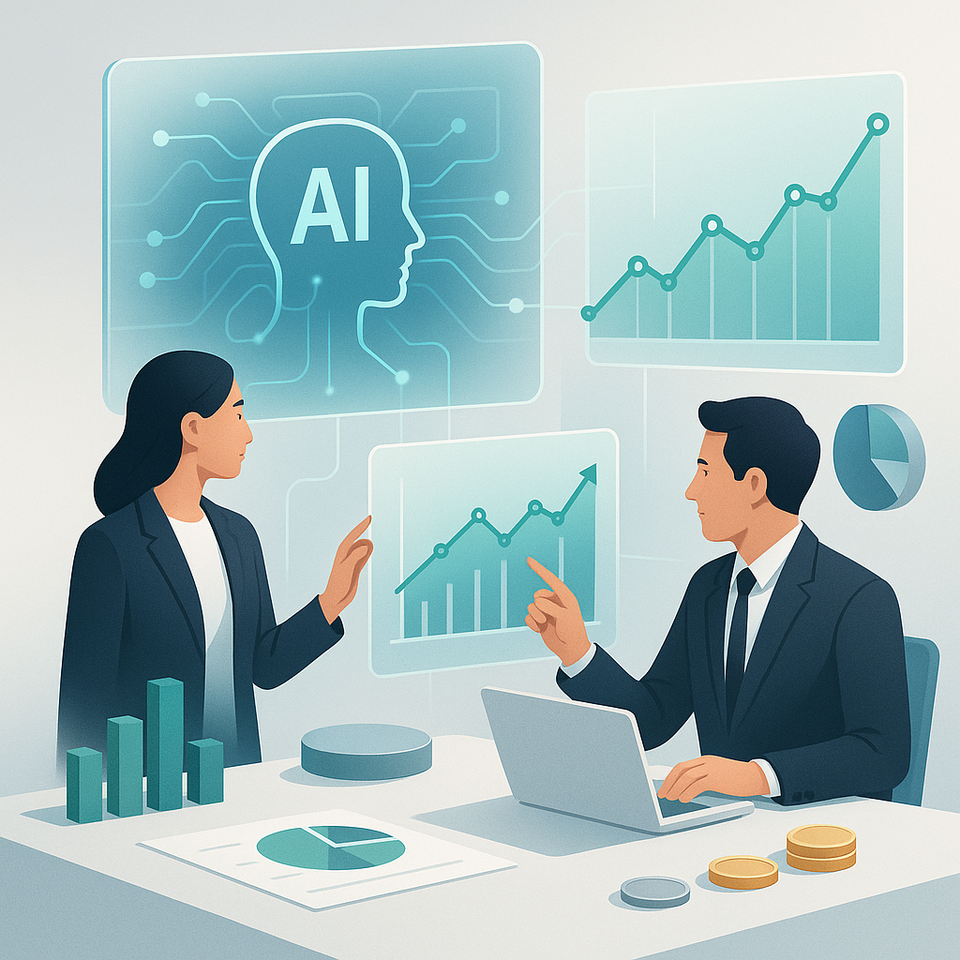
Introduction: The Rise of AI Long-Term Investments
AI long-term investments are fundamentally altering how portfolios are structured and managed in today’s rapidly evolving financial landscape. In 2025, artificial intelligence has become more than an emerging trend. It now represents the backbone of forward-thinking investment strategies for institutions and individuals alike. As capital allocation relies increasingly on advanced data analytics, knowing how AI impacts portfolio construction, risk assessment, and asset allocation is essential. The ability of AI to process vast amounts of information quickly provides both significant opportunities and unique challenges for long-term investors. Embracing AI-driven methodologies can create efficiencies and insights that traditional approaches could not achieve, making adaptation a necessity rather than a choice for those seeking sustained financial growth.
What Are AI Long-Term Investments?
AI long-term investments involve utilizing machine learning, neural networks, and other advanced algorithms to inform decisions about buying, holding, and selling assets over extended time frames. Unlike conventional strategies that rely on static models or historical averages, AI-based solutions interpret real-time data, identify new correlation patterns, and adapt to global macroeconomic shifts as they happen. This advanced analysis transcends classic algorithmic trading by delving into qualitative factors such as financial news, sentiment analysis, and geopolitical influences on asset classes. Modern AI systems learn continuously, updating their recommendations as new data becomes available. As a result, investors benefit from more flexible, responsive portfolio management that can identify subtle opportunities and risks invisible to human analysts. The spread of AI also democratizes access to these capabilities, as both institutional and retail investors now have tools once reserved for the largest financial players.
Why AI Matters for the Future of Long-Term Investing
For those pursuing long-term gains, AI offers a decisive advantage. It monitors economic signals, investment fundamentals, and market sentiment with a speed and depth unmatched by traditional research. More importantly, AI reduces the impact of emotional or behavioral biases that often lead to suboptimal decisions. In 2025, pension funds, insurance companies, and ultra-high-net-worth individuals increasingly entrust capital to AI-powered solutions capable of detecting inflection points in the economy before they become obvious. AI tools support strategic allocation choices, enabling investors to respond proactively to disruptions and smooth volatility over decades-long horizons. These capabilities also enhance the compounding effect, as smarter allocation and risk control help preserve gains through periods of market turbulence. By optimizing research and shortening response times, AI ensures investors can act swiftly on emerging risks and opportunities alike.
Core Elements of AI-Powered Investment Strategies
AI long-term investments rest upon several foundational pillars:
- Data Integration: AI analyzes structured and unstructured data, including financial statements, market feeds, economic indicators, and even social media trends to form a holistic investment thesis.
- Continuous Learning: Machine learning algorithms adapt to new datasets and changing conditions, improving their predictions and allocations over time.
- Emotion-Free Decision-Making: AI models rely on data and logic, activating buy or sell decisions without the cognitive biases present in human investors.
- Scenario Modeling: Modern AI systems simulate millions of scenarios to stress-test allocations and expose potential vulnerabilities across a range of market environments.
- Personalization: Investors receive tailored portfolio recommendations based on individual goals, risk tolerance, and liquidity needs, all dynamically reassessed as circumstances evolve.
Together, these elements create portfolios that adjust in real time, enhancing resilience and capturing growth potential more effectively than legacy strategies.
AI and Diversification: Building Smarter Portfolios
Diversification is a core tenant of long-term investing, and AI has revolutionized how it’s achieved. In 2025, leading robo-advisors and asset managers use deep learning to discover non-obvious connections among equities, bonds, commodities, and real assets. Instead of static sector weights or equal allocation models, AI-driven systems process data streams from global markets, economic releases, and alternative sources to update allocations dynamically. This process helps avoid overexposure to crowded trades or correlated sectors, reducing hidden risks within the portfolio. Modern AI frameworks can also detect regime shifts in volatility, adjusting portfolio mixes proactively instead of reactively. By simulating rare market disruptions or stress scenarios, AI tools further support robust diversification, ensuring that no single asset or risk factor can jeopardize long-term investment objectives. The result: investors achieve a steadier growth trajectory and stronger capital preservation.
Advancements in Risk Assessment with AI
Risk management has always been central to successful investing, but AI long-term investments elevate this discipline. Instead of relying solely on historical volatility or value-at-risk, AI risk models integrate live market information, credit trends, geopolitical analyses, and novel datasets such as weather patterns or shipping data. These systems break down risk into granular components—market, credit, liquidity, and operational risk—giving investors a comprehensive view of potential threats. Furthermore, AI can simulate millions of market paths, identifying which events or scenarios could inflict the most damage. When unexpected shocks occur, AI tools can automatically rebalance portfolios or suggest hedging strategies, maintaining alignment with long-term objectives. This resilience is especially valuable during economic uncertainty, as it supports capital preservation while allowing for opportunistic investment when markets recover. Overall, AI-enabled risk frameworks enhance both precision and flexibility for investors.
Real-World Examples and Institutional Use Cases
In 2025, practical AI applications are visible across the spectrum of long-term investing. Global pension funds use AI algorithms to manage demographic trends and asset-liability matching, ensuring future payouts remain solvent under multiple economic scenarios. Large endowments and sovereign wealth funds apply AI techniques to optimize multi-asset portfolios, factoring in complex variables like climate risk, ESG scores, and regional policy shifts. Family offices and high-net-worth individuals employ AI-driven platforms to align portfolios with personal values, financial plans, and evolving market conditions. On the retail side, fintech startups deliver AI-backed robo-advisory services that enable users to define objectives and risk budgets, then receive customized, automatically rebalanced portfolios. These platforms can even monitor news feeds and reweight assets in anticipation of central bank actions. Across all levels, AI enhances precision, responsiveness, and scalability for long-term investors.
Risks Unique to AI-Driven, Long-Term Investment Approaches
Despite their strengths, AI long-term investments introduce new forms of risk. Model risk comes to the forefront: if algorithms are trained on biased or incomplete data, they may make misleading recommendations. Opacity is another concern, as the complexity of deep learning can render decision logic inscrutable even to their creators. When many market participants use similar AI tools, systemic risks can increase—especially if models overreact to common signals. Cybersecurity threats also loom larger as financial systems become increasingly digitized and interconnected. Finally, regulatory oversight often lags technological advancement, exposing investors to legal and ethical uncertainties. Savvy investors address these risks by combining AI insights with sound judgment, thorough model validation, and robust oversight. Ongoing education is critical to keep pace with evolving technologies and maintain prudent governance.
Regulatory Developments and Industry Standards
As AI integration accelerates, regulators and industry organizations strive to set standards for transparency, accountability, and resilience. By 2025, major jurisdictions—including the US, UK, and EU—require investment firms to maintain detailed documentation on AI models, audit data pipelines, and test for bias regularly. The OECD and IMF have both published best practice guidelines for ethical AI application in finance. While regulation is still catching up with innovation, growing consensus among industry leaders has led to voluntary codes of conduct and information sharing partnerships. Robust compliance programs and independent model validation are now central to long-term investment success in the AI era.
The Continued Need for Human Judgment
Notwithstanding the sophistication of AI solutions, human insight remains vital. AI can process massive datasets and flag potential trends, but it is not infallible. Skilled investors and portfolio managers use AI as an advisor rather than an automatic pilot. Human intervention is crucial for interpreting rare, unprecedented events, as well as understanding the broader social and political context in which investment decisions are made. Teams with diverse skills—spanning data science, finance, and policy analysis—achieve better results by integrating algorithmic recommendations with real-world experience and intuition. This balance ensures that investors harness the full potential of AI long-term investments without abdicating responsibility or judgment.
The Role of Ongoing Education in AI-Driven Investing
Achieving sustainable success with AI long-term investments depends on continuous learning. The underlying technologies and models evolve rapidly, as do market conditions and regulatory requirements. Investors who stay informed about advances in AI, machine learning, and financial theory can adapt their strategies proactively. Leading financial institutions now offer training on both technical and ethical aspects of AI implementation, while industry bodies promote certification programs. Online platforms, such as [CFA Institute](https://www.cfainstitute.org/en/research), provide up-to-date resources for investors seeking to broaden their understanding of AI trends, best practices, and risk management techniques. By embracing lifelong learning, investors equip themselves to evaluate, adopt, and govern AI-driven solutions more effectively.
Conclusion
AI long-term investments have redefined modern portfolio management, introducing tools that vastly improve data analysis, risk response, and strategic allocation. The benefits for investors—enhanced diversification, agile risk management, and personalized strategy—are substantial. However, these advances come with challenges, including the need for strong oversight, ongoing education, and ethical vigilance. As AI-driven investing becomes the norm, successful portfolios will be built by those who blend technological innovation with informed, responsible human decision-making. Staying ahead in this landscape means embracing both advanced analytics and a commitment to continuous improvement, ensuring resilient, long-term financial prosperity.
 admin
admin