

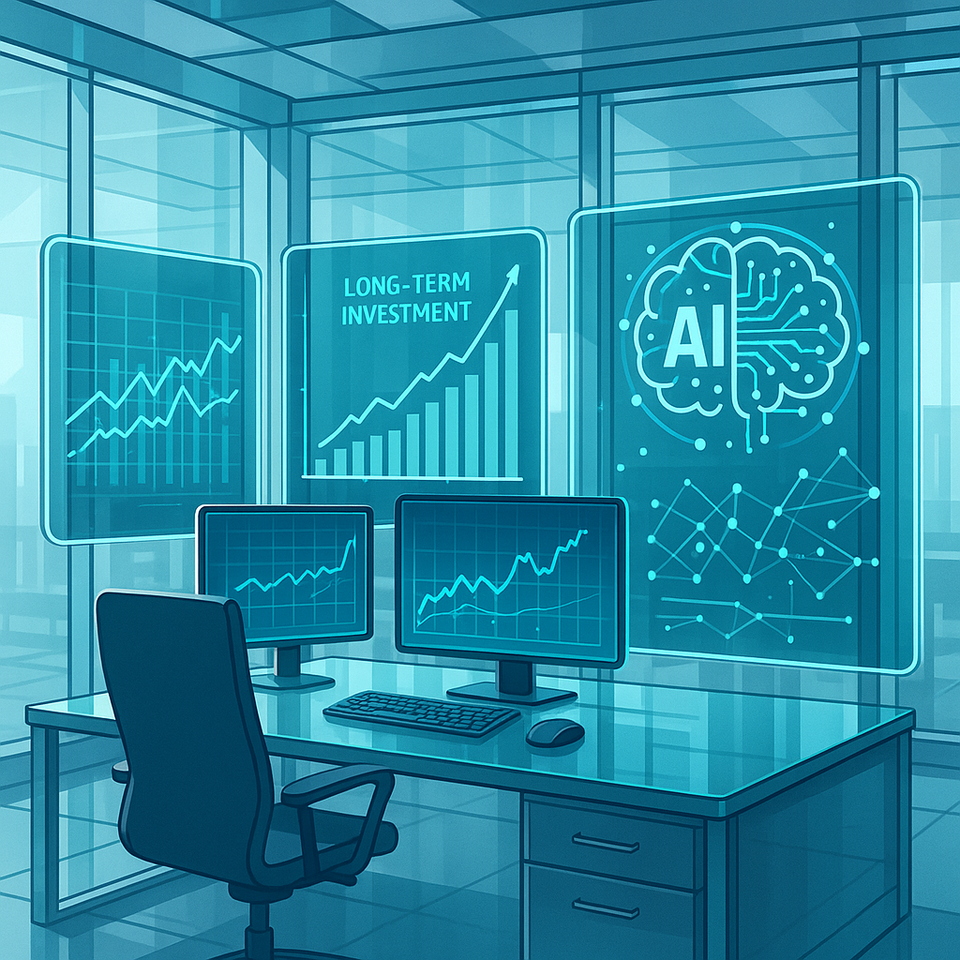
Introduction: AI Long-Term Investments and the Evolution of Financial Planning
AI long-term investments are altering the landscape of financial planning in ways that were once unimaginable. In an era filled with an overwhelming amount of information, investors are turning to artificial intelligence to help them distill data, reveal critical trends, and empower smarter decisions. As market dynamics become more volatile and interconnected, the importance of technological adaptation—especially in long-term portfolio management—cannot be overstated. Implementing AI not only amplifies traditional research capabilities but also anticipates market shifts that can define the difference between success and missed opportunity over decades. Therefore, understanding the principles behind AI-driven investing is essential for anyone intent on building a robust, future-proof financial strategy.
What Defines AI in Long-Term Investment Planning?
AI in long-term investment planning means using algorithms, predictive analytics, and natural language processing to automate and enhance financial decision-making. Unlike human-driven analysis, which is often limited by bias or information overload, AI-driven systems process vast and diverse datasets with speed and accuracy. They evaluate economic trends, company fundamentals, global market sentiments, and even social media posts to generate actionable insights. Moreover, AI applications enable continuous monitoring, more accurate risk assessments, and efficient allocation adjustments that align portfolios with long-term objectives.
The Advantages of AI for Long-Term Investors
AI long-term investments bring a wealth of advantages to investors disciplined enough to look beyond daily market noise. Most notably, AI can process real-time data from multiple sources, including global news, financial statements, satellite imagery, and even weather reports. This capability fosters superior forecasting, especially important for investments with horizons spanning years or decades. Automated portfolio rebalancing, risk scenario testing, and dynamic asset allocation are all accelerated by AI, leading to strategies that adapt nimbly to changing financial environments. Furthermore, AI-driven platforms can eliminate cognitive and emotional biases, ensuring that decisions remain grounded in data rather than reactionary impulses. This reduces the likelihood of costly mistakes often associated with human judgment.
Essential Technologies Powering AI-Driven Investment Strategies
Several core technologies underpin effective AI long-term investments. Machine learning enables systems to learn from historical and current data to refine predictions about asset behavior. Deep learning models can identify complex, non-linear relationships between macroeconomic factors and investment performance. Big data analytics equips investors with the tools to evaluate millions of data points from structured (e.g., financial reports) and unstructured (e.g., news articles) sources. Natural language processing, meanwhile, allows platforms to interpret regulatory filings, management commentary, and social sentiment—delivering a holistic view of the investing landscape. Robotic process automation frees professionals from repetitive tasks, allowing greater focus on strategic analysis. What sets these technologies apart is their ability to operate simultaneously, rapidly updating information and adjusting recommendations as market conditions evolve.
Practical Applications: Using AI in Your Long-Term Investment Portfolio
For individual investors and institutions alike, AI offers several actionable methods to strengthen long-term investment portfolios. One of the most widespread applications is the use of robo-advisors. These automated platforms conduct portfolio allocation and periodic rebalancing, using AI-driven algorithms to ensure that each client’s unique risk tolerance and time horizon dictate investment choices. Beyond mainstream robo-advisors, advanced analytic tools can stress test portfolios against historical shocks or hypothetical downturns. By leveraging alternative data—including satellite imagery, consumer trends, or supply chain intelligence—AI can alert investors to early signs of opportunity or risk. As a result, long-term investors gain access to information once confined to institutional finance, supporting more nimble and personalized strategy refinement.
Managing Risk: Key Challenges with AI Long-Term Investments
No strategy is risk-free, and AI-driven investing introduces its own unique complexities. The most pressing concern is model overfitting—when algorithms rely too much on past data, making them poorly suited to predict unprecedented future events. Technical glitches, coding errors, or unexpected changes in data quality can all disrupt portfolio performance. Excessive dependence on AI might lead investors to ignore necessary human judgment, a pitfall when markets move unpredictably. Another significant challenge is the risk of systemic shocks; if too many investors employ similar AI strategies, market movements can become amplified, resulting in exaggerated volatility. Data security poses another risk, as portfolios managed digitally are exposed to potential cyber threats. To navigate these challenges, investors should combine AI tools with human oversight, diversify their decision-making processes, and implement frequent model reviews.
Optimizing Portfolio Diversification with AI Insights
Portfolio diversification—one of the cornerstones of prudent investing—has evolved in the age of AI. Rather than relying solely on historical correlations and sector allocations, investors can now use AI models to dynamically assess changing relationships between assets. Machine learning tools monitor real-time factors that impact asset correlations, such as geopolitical developments, macroeconomic shifts, and industry-specific trends. These insights enable more informed rebalancing, providing a layer of adaptability previously unavailable. Moreover, AI’s ability to process structured and alternative data can uncover hidden diversification opportunities in emerging markets or asset classes. Ultimately, by optimizing portfolio composition through data-driven insights, investors reduce exposure to concentrated risks and enhance potential for long-term, compounded growth.
Behavioral Finance Meets AI: Avoiding Emotional Traps
One of the most significant benefits of AI long-term investments lies in its capacity to minimize emotional bias. Human investors often respond to market volatility with impulsive decisions rooted in fear or greed—leading to suboptimal outcomes. AI models, in contrast, operate with analytical discipline, grounded in objective metrics and predictive analytics. Many platforms now incorporate behavioral analytics to help clients identify patterns of irrational decision-making. Alerts can warn against panic selling or herd mentality, encouraging a steady, long-term approach. Not only does this stabilize returns, but it also reduces stress and supports healthy investor psychology, which is crucial for compounding gains over extended periods.
AI, ESG, and the Future of Responsible Investing
AI long-term investments increasingly intersect with ESG investing (Environmental, Social, and Governance criteria). AI’s advanced analytics empower investors to quantify and track ESG factors, such as carbon footprint, labor practices, and board diversity. By integrating non-financial data from diverse sources, AI systems deliver more comprehensive assessments of company sustainability and social impact. Moreover, as demand for responsible investing rises, AI enables investors to screen for ESG compliance efficiently, allocating capital toward businesses aligned with long-term societal values. The growing emphasis on transparent, explainable AI models further enhances trust, regulatory cooperation, and investor confidence in ESG-oriented portfolios.
Emerging Trends and the Democratization of AI-Driven Investing
Several emerging trends are making AI long-term investments accessible to a wider audience. Once reserved for institutional investors, AI-powered platforms are now catering to retail clients seeking sophisticated tools at lower costs. Innovations in real-time sentiment analysis, blockchain integration, and predictive portfolio optimization open new channels for personalized investment management. Furthermore, open-source AI initiatives and cloud-based analytics democratize access, empowering independent investors to experiment with custom models and alternative data sources. These trends signal a gradual shift toward more inclusive, technologically advanced investment ecosystems where everyone can benefit from AI’s efficiency and insight.
Best Practices for Implementing AI in Long-Term Investment Strategy
Successful adoption of AI in long-term investment planning involves several best practices. Start by clearly defining your goals, risk tolerance, and investment time frame. Choose reputable platforms or tools with transparent model architectures and strong security standards. Continuously monitor performance and update your strategy as market conditions or life circumstances change. Balance automation with human judgment—review AI-generated recommendations critically, especially in times of heightened volatility or uncertainty. Stay informed through ongoing financial education, as understanding basic concepts in both investing and AI technology anchors decision-making. Finally, seek professional advice as needed to ensure that portfolio construction aligns with your long-term objectives and risk capacity.
Integrating AI with Human Expertise: The Path Forward
Despite AI’s capabilities, the most successful strategies couple technology with human insight. Financial advisors leverage AI to enhance research or automate routine tasks, freeing time for relationship building and personalized guidance. Investors, meanwhile, must develop enough fluency to ask the right questions of their digital tools—never accepting outputs blindly, but using them as a springboard for deeper inquiry. Hybrid models—combining AI automation with personalized advice—will likely shape the next generation of investment services, blending efficiency with the irreplaceable intuition and holistic understanding that only experienced professionals can provide.
Conclusion: Building Resilience and Opportunity in AI Long-Term Investments
AI long-term investments offer a powerful edge in navigating today’s complex financial environment. By harnessing technology’s ability to process information, identify patterns, and adapt portfolio strategies dynamically, investors can unlock opportunities for growth that traditional methods may miss. These advances also bring new challenges, most notably the risks of overreliance or inadequate oversight, but diligent management and balanced adoption can mitigate such concerns. As AI continues to evolve, the investors who combine technological literacy with sound financial principles will be best prepared to build resilient, future-oriented portfolios. For deeper insights on diversification and technology integration, consult trusted resources such as the OECD report or your financial advisor.
 admin
admin