

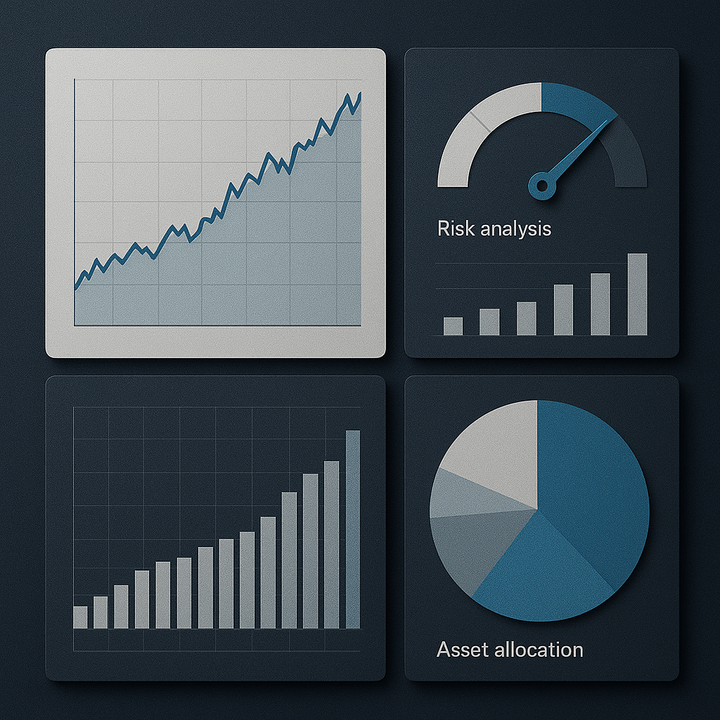
Introduction: The Relevance of Financial Risk Management in Today’s Markets
Financial risk management is vital in today’s global market. This is especially true for individuals managing complex personal portfolios across multiple asset classes and regions. As investors combine traditional assets with alternatives like private equity, derivatives, real estate, and digital currencies, new layers of risk emerge. These complexities require advanced techniques to safeguard wealth and ensure long-term growth. Therefore, mastering financial risk management has become essential for anyone seeking to maintain performance and resilience amidst growing market volatility.
Understanding Financial Risk Management in Personal Portfolios
Financial risk management means identifying, measuring, and controlling threats to the value and stability of a personal investment portfolio. For complex holdings, risk comes in many forms: market risk, credit risk, liquidity risk, concentration risk, operational risk, and even geopolitical risk. Individuals use a blend of quantitative methods, analytics platforms, and scenario planning to track exposures and adjust positions with precision. By evaluating risks across all investments, you gain the insight needed to make informed decisions and protect your financial future. Today, technology plays a central role. It delivers real-time analytics, automation, and deeper portfolio transparency.
The Importance of Financial Risk Management for Investors
Ignoring financial risk management can have significant consequences for investors with diversified or highly valued portfolios. Sudden market moves can rapidly reduce capital, threaten long-term goals, and undermine years of careful planning. Implementing a clear risk management framework provides a buffer against uncertainty. This helps you preserve and grow assets through various market cycles. Moreover, investors who understand their unique risk profile can stay disciplined even in stressful times, reducing the impact of emotionally driven decisions. Proper risk management also supports compliance for international investors and those with complex holdings. In all, robust risk controls are essential for successful asset allocation, capital stewardship, and the resilience needed to withstand global market dynamics.
Common Types of Financial Risks in Personal Portfolios
Effective financial risk management requires recognizing and quantifying key risk types. Here are the main categories:
- Market Risk: Exposure to changes in asset prices due to macroeconomic shifts, sector trends, or broad market events.
- Credit Risk: The possibility that a bond issuer or counterparty may default, affecting your returns and capital.
- Liquidity Risk: Challenges in converting assets to cash without heavy losses, common in alternative or privately held investments.
- Concentration Risk: Overexposure to a single sector, issuer, or asset class, reducing true diversification.
- Operational Risk: Issues stemming from process failures, system breakdowns, or mistakes by service providers.
- Geopolitical/Regulatory Risk: Uncertainty brought by political events, new regulations, or cross-border complexities.
By using data-driven tools and portfolio transparency, you can stay alert to each risk. This allows you to implement specific controls to reduce their impact.
Key Strategies for Effective Financial Risk Management
Building a strong risk management plan involves more than theory. It starts with a thorough analysis of your portfolio to map out where risks are concentrated. Here are several practical tactics:
- Scenario Analysis & Stress Testing: Examine how your portfolio would perform during market crises, rapid interest rate changes, or sector-specific shocks. This helps set realistic expectations and preemptively adjust exposures.
- Asset Allocation: Balance your holdings across asset classes to limit the impact of a downturn in any single area. Consider factors such as asset correlation, volatility, and liquidity. Tools like modern portfolio theory and multi-factor models are helpful for refining your mix.
- Position Sizing & Stop-Losses: Set proper limits on the size of each investment. Use stop-loss orders or trading bands to automatically exit positions that fall below your risk threshold. This limits potential losses.
- Rebalancing: Review and adjust the portfolio regularly. Rebalancing ensures your asset mix remains aligned with your original strategy, not swayed by recent market trends.
- Use of Derivatives: Options, futures, and swaps can hedge currency, interest rate, or commodity exposures. Use these instruments carefully, with a clear understanding of their risks and costs.
- Liquidity Planning: Hold enough liquid assets for unexpected needs. Stress test what would happen if you needed to sell illiquid holdings in a downturn.
- Independent Reviews: Seek regular assessments from financial advisors or risk specialists. Outside reviews help uncover blind spots or emerging threats.
Each of these strategies can be customized to your risk tolerance, financial goals, and investment horizon. Consequently, your risk management plan remains relevant as your situation changes.
Technology’s Role in Financial Risk Management
Advancements in financial technology have revolutionized risk management for investors. Automated trading platforms provide instant access to performance data and risk dashboards. Algorithms can optimize trade execution, flag outlier events, and rebalance portfolios based on predefined risk guidelines. Artificial intelligence and machine learning detect non-obvious correlations, signals of impending market shifts, and opportunities for more efficient hedging.
Additionally, blockchain platforms provide secure, transparent records of asset ownership and transaction history. This makes it easier to verify exposures and reduce operational risks. Meanwhile, digital aggregation tools pull information from multiple accounts and providers, helping you gain a holistic view of your portfolio risks in real time.
Technology also democratizes risk management tools, making features once reserved for institutions available to individual investors. This shift levels the playing field and empowers more personal control over risk-adjusted returns.
Balancing Risk and Reward: Diversification, Leverage, and Alternatives
A core aim of financial risk management is balancing reward with acceptable risk levels. Diversification remains the simplest, yet most powerful, method. Spreading investments across asset classes, sectors, regions, and strategies helps dilute individual risks and smooth overall performance.
Investors also increasingly add alternative investments—such as real estate, hedge funds, venture capital, or private credit. While these assets may offer high returns and low correlation to traditional markets, they bring challenges like limited liquidity, valuation uncertainty, and complex structures. Therefore, proper due diligence and scenario analysis are crucial before allocating significant capital to alternatives.
Some adopters use leverage to amplify returns. However, leverage increases the scale of both gains and losses. Managing margin requirements, loan covenants, and automatic liquidation triggers becomes mandatory. Stress-testing leveraged positions ensures you’re not overexposed to tail risks.
Ultimately, balancing risk and reward is dynamic. Regular review, adjustment, and learning are mandatory as markets, asset classes, and global events evolve.
Advanced Concepts in Portfolio Risk Management
Seasoned investors can further enhance financial risk management by integrating advanced portfolio analytics:
- Value at Risk (VaR): Calculate the potential loss in a portfolio under normal market conditions over a set period. This metric quantifies the risk of significant downside.
- Conditional Value at Risk (CVaR): Measures the average loss when extreme negative events occur. This provides a complementary risk estimate to VaR.
- Drawdown Analysis: Track the peak-to-trough declines in a portfolio to assess exposure to sharp losses.
- Risk Budgeting: Assign set limits for each type of risk. This helps direct capital toward opportunities that fit your overall tolerance.
- Factor Analysis: Isolate drivers of risk and return such as momentum, value, or yield. This supports more nuanced portfolio construction and monitoring.
These approaches support a deeper level of oversight. They help drive informed decisions as portfolios diversify and grow in complexity.
The Human Side: Psychology and Behavioral Traps in Risk Management
Effective financial risk management depends not just on process, but also on the investor’s mindset. Behavioral finance reveals how biases—such as overconfidence, loss aversion, or the tendency to chase recent winners—can undermine even the best strategies. Clear risk rules, alongside consistent process and independent feedback, help control impulsive reactions. By analyzing past behaviors during stressful markets, investors can develop emotional discipline. This discipline helps uphold chosen risk parameters during periods of volatility.
Education and Ongoing Learning for Risk-Aware Investors
Financial markets, technology, and regulations change rapidly. Therefore, continuous improvement is core to financial risk management. Regular learning—through research, courses, peer exchanges, and professional advice—helps investors stay informed. This ongoing education enhances your ability to detect new risks, adapt strategies, and adopt leading-edge tools.
Additionally, well-informed investors are better positioned to communicate requirements and expectations with financial partners, family members, or estate planners. This supports long-term financial plans and legacy goals.
Integrating Financial Risk Management Into Your Personal Finance Strategy
For successful long-term wealth creation, financial risk management should be central to your broader personal finance approach. Begin with clear documentation of your goals, risk tolerance, and constraints. Develop a customized investment policy statement (IPS) that spells out your allocation targets, rebalancing intervals, liquidity needs, and risk parameters. Collaborate with knowledgeable advisors to periodically review your IPS. Update your risk plan after life milestones or major market events.
Emphasize portfolio transparency—know what you own, the underlying drivers of risk, and the cost and complexity of each position. Schedule regular reviews to ensure your risk exposures remain consistent with your objectives and capacity for loss.
Conclusion: Stay Adaptive and Proactive With Financial Risk Management
Managing financial risk in complex personal portfolios demands commitment to rigorous analysis, continual learning, and flexible adaptation. With markets and technology evolving swiftly, robust financial risk management strategies can help secure your wealth in the face of uncertainty. Use technology, prudent diversification, and independent advisory review to maintain control. Always align your approach with your long-term goals, risk capacity, and evolving circumstances. For more comprehensive insights, resources, and expert guidance, explore our dedicated Advanced Personal Finance section.